Skip to content

Saturday, 4 July 2026

Welcome to a new issue of This Week in Plasma!

This week Plasma 6.7 received a few more stabilization bug-fixes while attention turned towards the upcoming 6.8 release. Some exciting changes are in progress, and a few have already merged, including highly visible improvements to some common animations.

Check it out!

Notable new features

Plasma 6.8

Updated the Emoji Selector app to version 17 of the Unicode emoji standard, giving you access to derpy new emojis like “🫪️”. (Jens Jerosch, plasma-desktop MR #3849)

New emojis in Emoji Selector app

Notable UI improvements

Plasma 6.7.2

Moved the global “Move Mouse to Focus” and “Move Mouse to Center” actions out of the Zoom effect, so they still work even if you’ve globally disabled the Zoom effect. (Vlad Zahorodnii, KDE Bugzilla #522070)

Plasma 6.7.3

Made KRunner’s Bookmarks search provider return results for 2-character queries (so it will match “Qt”, for example), and use fewer system resources. (Kai Uwe Broulik, plasma-workspace MR #6764)

The Clipboard widget’s Actions Configuration page now uses better internal margins for the content. (Levi Leal, plasma-workspace MR #6779)

After After
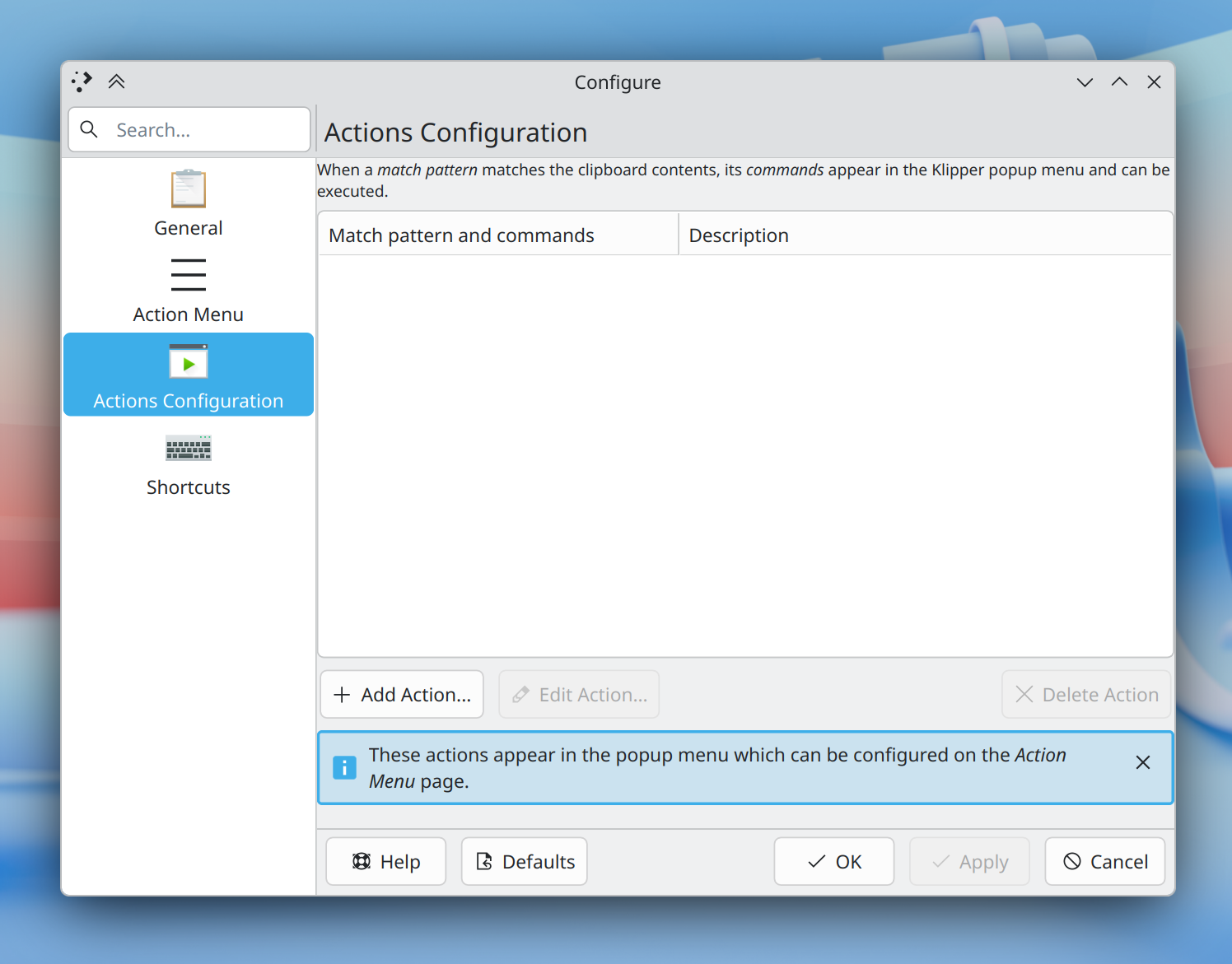
Before Before

Plasma 6.8

The “Bouncing app icon” launch feedback style now uses a more visually pleasing animation with a better physics model, a more appropriate easing curve, and a higher frame-rate. (The Entropyist, kwin MR #9487)

The new sliding animation for notifications now uses a more natural easing curve, so it looks even better than it already did! (Thomas Duckworth, KDE Bugzilla #522276)

There’s no longer a secret keyboard shortcut (previously Meta+Ctrl+x) that turns on clipboard actions. This was easy to press by accident, and would then make weird popups appear when you copied URLs. (Tobias Fella, plasma-workspace MR #6773)

The Digital Clock widget now requests “tabular numerals”, which are monospaced digits supported by some fonts. The use of these numerals prevents the clock from changing its width as time passed in a few edge cases where the existing code to prevent that wasn’t good enough. (Christoph Wolk, plasma-workspace MR #6797)

Discover’s old “CD and DVD” category is now named “Disc Burning”, because that’s what apps expect it to be, which explains why it only contained disc burning apps. (Nate Graham, discover MR #1350)

After After
Before Before

And before you ask: no, we couldn’t instead change the category to include all apps related to CDs and DVDs, because it’s a standard category governed by a FreeDesktop spec, and to do that, we’d need a new one.

Info Center’s Memory page now shows a busy indicator if it takes more than a moment to load. (Kai Uwe Broulik, kinfocenter MR #305)

You can now find the System Settings page responsible for the “press and hold a key to see alternative characters” popup, so you can more easily turn it on or off or change how the delay before it appears. (Kristen McWilliam, plasma-keyboard MR #154)

The DrKonqi crash reporting wizard now tells you when it’s safe to close the window. (Antti Savolainen, drkonqi MR #397)

Notable bug fixes

Plasma 6.6.6

Hardened the Task Manager widget against maliciously-crafted .desktop files for apps (David Edmundson, plasma-workspace MR #6817).

Hardened the ksystemstats_intel_helper process against path traversal attacks. (Matthias Gerstner, ksystemstats MR #141)

Plasma 6.7.2

Fixed a recent regression that made certain screens incorrectly notify about being disconnected and re-connected in a loop after they want to sleep. (Xaver Hugl, KDE Bugzilla #521826)

Fixed a recent regression that produced corrupted visuals on some rotated screens and with some older AMD GPUs. (Xaver Hugl, KDE Bugzilla #521878 and KDE Bugzilla #521764)

Fixed a recent regression that broke the ability to drag desktop files and folders between screens. (Marco Martin, KDE Bugzilla #521713)

Fixed a recent regression that made SDR content look a bit de-saturated for some screens while in HDR mode. (Xaver Hugl, KDE Bugzilla #521759)

Fixed a recent regression that made certain ICC profiles show the wrong colors. (Xaver Hugl, KDE Bugzilla #522301)

Fixed a recent regression that made KWin lag and hang when playing certain poorly-optimized games via Proton. (Vlad Zahorodnii, KDE Bugzilla #522005)

The implementation of the new “press and hold for alternative characters” feature now prioritizes compatibility for apps, fixing a massive number of bugs. (Kristen McWilliam, plasma-keyboard MR #152)

The new Vietnamese calendar now shows the correct dates. (Trần Nam Tuấn, KDE Bugzilla #522099)

The new feature to show how much earlier or later a time zone is than your current one now correctly calculates the value for time zones with a half-hour offset that are earlier than your local time zone. Time is hard. (Michael Kohl, KDE Bugzilla #522037)

Forcing the use of the software pointer no longer makes it disappear when a window pushes a panel in “Dodge Windows” mode into its hidden state. (Xaver Hugl, KDE Bugzilla #521953)

The Mouse page in System Settings no longer shows layout glitches on X11. (Marco Martin, KDE Bugzilla #521992)

Text on the Networks widget’s Details tab can no longer visually overflow when it’s really long. (Manuel Alcaraz, KDE Bugzilla #522333)

Plasma 6.7.3

The “Kameleon” system service is now disabled by default, which prevents it from applying a color to your keyboard’s backlit keys even if the feature to apply colors to RGB keyboard backlighting disabled. The context here is that we added support for the Steam Machine’s LED strip, and this also made it work for many keyboards, but exposed a pre-existing bug. (Oliver Beard, KDE Bugzilla #521793)

Spectacle no longer includes the tooltip showing image dimensions in the final screenshot if you accept a rectangular region by double-clicking it. (Noah Davis, KDE Bugzilla #513715)

Plasma 6.8

Fixed the most common crash in Plasma, which could happen once in a while when using multiple screens. (Marco Martin, KDE Bugzilla #500044)

Minimizing the window of an RDP client no longer stops the video stream. (Shouvik Kar, KDE Bugzilla #497765)

Frameworks 6.28

XWayland-using apps no longer start to behave in a couple of weird and quirky ways after XWayland itself crashes and restarts. (Vlad Zahorodnii, kwindowsystem MR #220)

Notable in performance & technical

Plasma 6.7.3

Fixed a recent performance regression that increased KWin’s CPU usage on some Intel systems using atomic mode-setting. (Xaver Hugl, KDE Bugzilla #522075)

Plasma 6.8

Implemented support for version 1.6 of the Emulated Input system. (David Edmundson, kwin MR #9112)

KWin now internally only uses OpenGL ES, which ensures that it will always be working since everyone will be using it — at least until Vulkan support is farther along. OpenGL ES is necessary for some old GPUs and turns out to be sufficient for everything KWin needs anyway, so we don’t anticipate any downsides from this change. (Xaver Hugl, kwin MR #9488)

How you can help

KDE has become important in the world, and your time and contributions have helped us get there. As we grow, we need your support to keep KDE sustainable.

Would you like to help put together this weekly report? Introduce yourself in the Matrix room and join the team!

Beyond that, you can help KDE by directly getting involved in any other projects. Donating time is actually more impactful than donating money. Each contributor makes a huge difference in KDE — you are not a number or a cog in a machine! You don’t have to be a programmer, either; many other opportunities exist.

You can also help out by making a donation! This helps cover operational costs, salaries, travel expenses for contributors, and in general just keeps KDE bringing Free Software to the world.

To get a new Plasma feature or a bug fix mentioned here

Push a commit to the relevant merge request on invent.kde.org.

Friday, 3 July 2026

Tellico 4.2.1 is available, with some improvements and bug fixes.

Improvements:

  • Added user-defined data fetch argument (Bug 516055).
  • Updated Google Scholar and Colnect data sources.
  • Updated Google Books data source (Bug 522095).
  • Updated external data source to allow termination by user (Bug 516057).
  • Updated to allow multiple ISBN values (Bug 521157).
  • Updated Album template to hide empty track tables and use loan information.
  • Increased minimum image reader memory limit.

Bug Fixes:

  • Fixed bug with exporting linked images (Bug 522094).
  • Fixed bug with parsing field names with emoji (Bug 521148).

Let’s go for my web review for the week 2026-27.


What happened to the fight for the Internet?

Tags: tech, politics, surveillance

Excellent piece, where are the netizens who should be fighting back those bills? Looks like we became very complacent and passivity reigns this time around. Didn’t think it was related to the pervasive centralisation already in place… but indeed that might be a strong contributing factor.

https://dustycloud.org/blog/what-happened-to-the-fight-for-the-internet/


Age verification is just a precursor to attribution of speech

Tags: tech, politics, law, surveillance

Definitely this, we can’t trust this kind of mechanism for what they open the door to.

https://nonogra.ph/age-verification-is-just-a-precursor-to-attribution-of-speech-06-29-2026


my review of uruky

Tags: tech, web, search

Several times I bump into articles praising this one. I’ve been test driving it a bit, the experience is still a bit bare but it’s clearly maturing. Definitely an option to keep an eye on in my opinion.

https://blog.sulimans.space/my-review-of-uruky/


Zuckerberg’s increasingly bizarre war on whistleblowers

Tags: tech, social-media, facebook, ethics

There might be a method behind the madness of the thin skinned autocrat heading Meta… Unfortunately it probably works.

https://pluralistic.net/2026/06/27/zuckerstreisand-2/


Chatbots vs. Ozone

Tags: tech, geospatial, ai, machine-learning, gpt, economics, ecology

More reasons why the whole “data centers in space idea” is stupidly dangerous and likely unreachable.

https://blog.dshr.org/2026/05/chatbots-vs-ozone.html?m=1


Claude Code Is Steganographically Marking Requests

Tags: tech, ai, machine-learning, gpt, copilot, trust, security, privacy

You sure you can trust those systems? It’s proprietary software and they’re clearly on a slippery slop. For something so security sensitive this is concerning.

https://thereallo.dev/blog/claude-code-prompt-steganography


Prompt Injection as Role Confusion

Tags: tech, ai, machine-learning, gpt, cognition, security, safety

Interesting paper (go to the full one for all the details) which shows that with the current architecture it’s really hard if not impossible to make safe systems with LLMs. This gives interesting insights in the weird form of proto-cognition those models exhibit.

https://role-confusion.github.io/


Text Editor: Data Structures

Tags: tech, text, editor, design

Neat introduction to the right data structures to use when making a text editor.

https://www.averylaird.com/programming/the%20text%20editor/2017/09/30/the-piece-table.html


Engineering High-Performance Parsers with Data-Oriented Design

Tags: tech, data-oriented, architecture, performance, parsing

Interesting article applying data oriented design to parsing tasks. This is really a good approach for performance.

https://www.arshad.fyi/writings/engineering-high-performance-parsers


Data Access Patterns That Makes Your CPU Really Angry

Tags: tech, cpu, memory, hardware, performance

Interesting experiment on how to totally break the performance of memory accesses. This gives good insights on the whole chain works.

https://blog.weineng.me/posts/slowest_add/


The Physics of Memory

Tags: tech, javascript, memory, data-oriented, performance

Unsurprisingly cache locality is a very important factor. What’s interesting here is that it still applies to a language like Javascript where you’d expect to not have enough control on the memory layout to reap any benefits.

https://www.dmurph.com/posts/2026/06/ecs_vs_oop_benchmark/ecs_vs_oop_benchmark.html


High-performance Rust: Understanding and eliminating memory fragmentation

Tags: tech, rust, memory, embedded, performance

Interesting Rust options to limit the amount of heap allocations if you’re constrained by memory or for performance reasons.

https://kerkour.com/rust-high-performance-memory-fragmentation-allocations


Hobby’s algorithm for aesthetic Bézier splines

Tags: tech, graphics, mathematics

Interested in splines? This is a gentle introduction which points to further resources if you want to implement them.

https://www.jakelow.com/blog/hobby-curves#fn-2


What To Learn To Be A Real Time Graphics Programmer

Tags: tech, 3d, shader, mathematics, graphics

Wondering what to learn to get into graphics programming? This is a nice list.

https://blog.demofox.org/2026/07/01/what-to-learn-to-be-a-graphics-programmer/


Announcing Box3D

Tags: tech, physics, simulation, 3d

Exciting! This looks like a neat 3D physics engine.

https://box2d.org/posts/2026/06/announcing-box3d/


The essence of architectural work

Tags: tech, architecture, complexity

This is an ongoing series, but there are good insights about software architecture work in the first few articles. Shows quite well the important tradeoffs and the usual traps.

https://www.ufried.com/blog/essence_of_architecture_1/


Every bottlenose dolphin invents a unique whistle that becomes its name

Tags: biology, nature, cognition

So using personal names is not an inherently human trait, this is confirmed through research now. Before their were signs and suspicions, but now the trail of evidences is strong.

https://spacedaily.com/d-within-the-first-few-months-of-life-every-bottlenose-dolphin-invents-a-unique-whistle-that-becomes-its-name-for-the-rest-of-its-life-and-other-dolphins-learn-that-whistle-remember-it-and/


Notes from a burning Paris

Tags: climate, ecology

This is what things will look like in the coming years. Only probably worse, and for more and more people.

https://sarahwilson.substack.com/p/notes-from-a-burning-paris


Bye for now!

A couple of months ago I improved some of our dialogs and this time I worked on some more. Did you know that you can just paste the clipboard’s content into the Dolphin file manager or on the desktop to create a new file from it?

Dialog box "Paste Clipboard Content" prompt for "Filename for clipboard content:". Name is "pasted file.html"
Just paste your clipboard’s content to create a new file

Tobias Fella added a proper “platform message dialog” for Qt to use. This replaces the hideous Qt Quick message dialogs you could see in some places. With that, we are also finally able to play our message box sounds for Qt-only applications using QMessageBox (instead of KMessageBox or KMessageDialog). To do this, Qt sends an QAccessible::Alert event that is then handled by the relevant platform accessibility integration. On Windows it for example calls the win32 PlaySound API. However, I didn’t want to mess with Qt’s AT-SPI1 stack just for this. Now that we provide a custom dialog, we might as well play the sound from there.

Just like the “New File” dialog, the paste dialog mentioned above also displays the file icon now. It also tries to guess what kind of file it is and automatically suggests a matching file extension. For example, copying something that looks like HTML will suggest the name “pasted file.html”. You are of course still free to choose a different file name and extension.

An application can also suggest a name using the custom application/x-kde-suggestedfilename MIME type. Spectacle does this so a screenshot copied to clipboard and then pasted (rather than saved directly) will nevertheless use a “Screenshot_xyz” file name. The clipboard history now remembers the suggested name when it stores an entry so when you recall it later it will still use that name as expected.

Configuration dialog “Color Themes”, select theme drop.down with various themes and each one has a little colored square preview for the colors
Little preview icon when configuring syntax highlighting

When dropping a folder into Kate, all files contained within will be opened. Kate has always been able to open files on remote locations thanks to KIO but the drag and drop code only worked with local folders. This is now fixed and you can drop a folder from a SMB or other share into your Kate the same way as any local one.

A nifty addition to both the menu and settings page for choosing a syntax highlighting color scheme is a little preview icon similar to the application color scheme. This lets you roughly judge the appearance of the theme before selecting it.

Finally, KWin’s debug console (Open KRunner, type “KWin”) received a “Pick Window…” button. This way you can more easily find a particular window in the potentially long list of windows. The kwindowprop tool (KWin’s equivalent to xprop) now also includes the PID of the process owning the window.

  1. Assistive Technology Service Provider Interface, a cross-desktop accessibility framework ↩

Thursday, 2 July 2026

This week I shipped two new features for KeepSecret. KWallet XML Import (!34)

The Import menu on the wallet page is now a submenu with two options:

-KeepSecret…

-KWallet XML…

Both import formats are converted into the same internal format, allowing them to use the existing import code. I only implemented import support, since exporting to the old KWallet format wasn't necessary because KWallet is being deprecated.

Password Generator (!35)

I added a Generate button to the Create New Entry dialog. Clicking it generates a random 16-character password and fills the password field.

The password is generated in SecretItemProxy::generatePassword() using QRandomGenerator::global(), which uses the operating system's secure random source. A character set is built from the selected options (lowercase letters, uppercase letters, numbers, and symbols), and each character is chosen randomly from that set. This also allows passwords to include symbols like !@#$%^&*.

The function returns a QByteArray instead of a QString, matching the existing code and avoiding an unnecessary copy of the secret in C++.

During code review, Michael K83 pointed out that secrets stored in normal QByteArray or QString objects are not automatically erased from memory after use. He suggested looking at how ksecretd and KeePassXC handle secure memory.

Marco Martin explained that an even bigger challenge exists once the password reaches QML. The password becomes a QString inside the QML engine, where Qt may create multiple internal copies that cannot be explicitly cleared. It will be addressed separately in issue #25.

Over 180 individual programs plus dozens of programmer libraries and feature plugins are released simultaneously as part of KDE Gear.

Today they all get new bugfix source releases with updated translations, including:

  • elisa: Change output device when global output is changed (Commit, fixes bug #512126)
  • kdeconnect: Fix file transfers when notification sending is enabled (Commit, fixes bug #516765)
  • kdenlive: Fix timeline playhead going out of view while playing (Commit, fixes bug #517494)

Distro and app store packagers should update their application packages.

Wednesday, 1 July 2026

At FOSDEM 2025 I presented my (intentionally controversial) proposal how to keep copyright and licensing info in minified JS/CSS and asked for feedback, including from front-end developers.

Two months later, I took the feedback from FOSDEM and held a small workshop session with a group consisting of OSPO leaders, FOSS lawyers and a handful of FOSS developers at LLW 2025.

This blog post was finished1 more than a year after both, so I will not be summarizing my FOSDEM talk, and suggest you listen to it (esp. the Q&A part), if you are interested in the details.

But I will summarize the results of both sessions below.

Are SDPX IDs enough for compliance or not (given their templating)

Someone argued that for certain licenses – specifically, e.g. the MIT and BSD family – even the SPDX License List has a some templating in place, and as such identifying it with just an SPDX ID would not fulfil the license obligations, by strict reading of the license.

That is a concern that I identified already in my original proposal and I agree that my proposed approach has a certain amount of “handwaving”, which is not 100% risk-proof.

(Spoiler: we fix this issue in the final proposal. Wait for the next blog post in this series.)

Impact on size of the minifed code

A common concern from web developers was how much keeping the SPDX/REUSE tags in the minified code would impact the its size.

With the help of the wonderful Lukas Taegert-Atkinson of Rollup fame, we managed to get a good idea what the impact adding REUSE/SPDX tags to all the files would have on the size of the minified code.

As an PoC Lukas made the following change to the build process of Rollup Browser, so we could compare the size of the minified code before and after the diff.

diff --git a/rollup.config.ts b/rollup.config.ts

--- a/rollup.config.ts  (revision 384d5333fbc3d8918b41856822376da2a65ccaa3)
+++ b/rollup.config.ts  (date 1742569205307)
@@ -152,7 +152,22 @@
            collectLicensesBrowser(),
            writeLicenseBrowser(),
            cleanBeforeWrite('browser/dist'),
-           emitWasmFile()
+           emitWasmFile(),
+           {
+               name: 'add-fake-tags',
+               transform(code) {
+                   return {
+                       code: `/*!
+* SPDX-SnippetBegin
+* SPDX-SnippetCopyrightText: © 2021 Test Dummy <dummy@test.example>
+* SPDX-License-Identifier: BSD-2-Clause
+*/
+${code}
+/*! SPDX-SnippetEnd */`,
+                       map: { mappings: '' }
+                   };
+               }
+           }
        ],
        strictDeprecations: true,
        treeshake

If Rollup Browser was built as per default, the full minified code resulted in 374 KiB.

After the patch that caused (dummy) snippet-level SPDX tags to be inserted into all the code (Rollup itself and its dependencies), the size grew to 415 KiB though.

That is a 11% increase in size. Not exactly negligible, but definitely far from terrible. And if tooling were to be updated, with de-duplication we could possibly take that number down quite a bit too.

In the previous tiny Svelte + Rollup + Terser PoC, both with and without SPDX tags are 12 KiB, so we need take a magnifying glass to compare 12.681 bytes with tags, and 12.324 bytes without them – that is just a 3% difference.

And in the previous React Scripts (+ WebPack + Terser) PoC, the overall build size is virtually unchanged, but oddly enough while some files become bigger, others become smaller.

With REUSE tags, the total size of build/static/ is 536 KiB (specifically, 531.070 bytes):

build/static/css:
.rw-r--r-- 1.038 hook  3 apr 01:54  main.05c219f8.css
.rw-r--r-- 1.759 hook  3 apr 01:54  main.05c219f8.css.map

build/static/js:
.rw-r--r--   4.534 hook  3 apr 01:54  453.2a77899f.chunk.js
.rw-r--r--  10.597 hook  3 apr 01:54  453.2a77899f.chunk.js.map
.rw-r--r-- 143.544 hook  3 apr 01:54  main.608edf8e.js
.rw-r--r--   1.205 hook  3 apr 01:54  main.608edf8e.js.LICENSE.txt
.rw-r--r-- 368.393 hook  3 apr 01:54  main.608edf8e.js.map

and without the SPDX tags, the total size of build/static/ is also 536 KiB (specifically, 529.880 bytes):

build/static/css:
.rw-r--r--   779 hook  3 apr 01:53  main.f855e6bc.css
.rw-r--r-- 1.427 hook  3 apr 01:53  main.f855e6bc.css.map

build/static/js:
.rw-r--r--   4.534 hook  3 apr 01:53  453.2a77899f.chunk.js
.rw-r--r--  10.597 hook  3 apr 01:53  453.2a77899f.chunk.js.map
.rw-r--r-- 143.544 hook  3 apr 01:53  main.608edf8e.js
.rw-r--r--   1.070 hook  3 apr 01:53  main.608edf8e.js.LICENSE.txt
.rw-r--r-- 367.929 hook  3 apr 01:53  main.608edf8e.js.map

Which is a difference of measly 0.2%.

Lukas was also quick to point out that a ballpark estimation of how much extra space this would take is quite easy to calculate, as all it is needed is to count all files that would be included in the final JS (or CSS) bundle and multiply that with the size of the SPDX tags. As such, the impact would be bigger on projects that have many very short source code files, while smaller on those that have fewer, but longer source code files. Again, this is without taking any de-duplication into account.

So we can come up with a generic formula:

size = normal_minified_size + (number_of_files × 4_extra_lines)

What was the cause of the problem with the Snippet-Begin and Snippet-End tags?

You may recall in my original proposal that there was an issue with the SPDX-Snippet-Begin and SPDX-Snippet-End tags being jumbled in the resulting minified code.

According to Lucas, this is most likely something Terser caused when associating comments to functions and then optimizing the code. He is fairly positive it can be solved though.

(Again, spoiler: this will be a moot issue in the end. Wait for the next blog post.)

Do we need tags in the minified code?

Of course, a very good question is whether we need the REUSE/SPDX tags in the minified code itself. Especially, given that we do not require something as strict for other non-source code (e.g. compiled code).

I admit, I do not think we actually need to.

To be honest, why that is in the original proposal, is because I was trying to push just how far we can bring license compliance in client-side JS/CSS by just leveraging already existing standards and tools. It turns out we can push it very far – arguably ad absurdum ;)

So, no, I do not think we need that, but it was a good thought experiment and I think it was necessary to get discussion going2.

Alternative proposal: SBOM

But if we do not keep it in the code we ship, where do we keep the license/copyright info then?

At LLW 2025 we had a pretty intense session where ultimately we came up with an alternative proposal to generate an SBOM and ship that instead. This solves a lot of issues and is something that license compliance officers are already familiar with. It would also bring it closer to how we manage licensing when shipping non-web software.

The SBOM approach would require use of tooling and by the end of the day we were left with a bunch of loose threads, but in general, this sounds like a good way forward.

Conclusion: plan B in the making

Was all the effort now wasted?

Not at all.

Web pages and (SaaS) web applications are still a bit of a different beast, so we learned a lot in the past two years due to this exercise.

I am pretty confident we now have a way how to fulfil the license obligations:

  • without making the web page too heavy;
  • burdening web developers any more than other programmers;
  • shipping machine-readable compliance artifacts; as well as
  • making the information ready for human consumption too.

In the next blog post I will present the final proposal.

hook out → I think we’re slowly onto something …


  1. I am truly sorry, but there was just way too much going at work and in private, so I neglected my blogging for some time. 

  2. You know the old adage: The fastest way to get an answer to your question on the internet, is to provide a false anwser and wait for everyone to rush to correct you ;) 

Image

Welcome to another edition of “This month in KDE Linux” — KDE’s in-progress operating system.

This month was pretty smooth; we had no build delivery drama, and all OS images we shipped were of satisfactory quality. The project is maturing, and we’re 78% of the way towards completing the beta milestone.

QA & testing

Bhushan Shah and Thomas Duckworth continued working on the project to build a robust and modern automatic QA system. It’s really really close to being integrated at this point, and will act as a full-stack integration test for all of KDE Plasma in addition to a test system for KDE Linux specifically.

More user-friendly installation

Hadi Chokr did the huge amount of work necessary to transform KDE Linux’s .raw image file into a hybrid image that’s also a valid .iso file! This allows KDE Linux to be installed more easily using VM software that often expects to be given an .iso file.

Remember that you’ll still need to turn on UEFI mode, as KDE Linux still intentionally doesn’t support the legacy BIOS system!

Better audio CD ripping

Harald Sitter, Jan Rathmann, and I completed a small project to get KDE’s Audex app up on Flathub as a replacement for the audiocd-kio software we had previously been pre-installing on the image.

The problem with audiocd-kio is that it included two System Settings pages of questionable utility that offered a fairly old-fashioned UX. Now we don’t include those things, and instead we document how to download Audex and use it to rip CDs. And this way, you get automatic metadata lookup, too!

Easier log collection

Felix Araújo built a tool to ease the collection of logs called collect-logs. It also does some data sanitization. This will be very useful for bug reporting purposes!

Rudimentary “Developer Mode”

I created a very simple system to show and hide developer tools, and they’re hidden by default until you run toggle-developer-mode, which is documented here.

This reduces clutter in the launcher widgets of users who aren’t software developers. In the future we’ll add more to this script, and we might consider moving more tools off the base image and into Flatpak apps or even downloadable meta-packages, thereby coming full circle by re-inventing packaging. Go figure.

Documentation

I wrote documentation for how to configure input methods for Chinese, Japanese, Korean, and Vietnamese text input, in consultation with several speakers of these languages.

And in the near future, we plan to pre-install some of these tools to make things easier for the world’s 1.7 billion people who use one of them to communicate on their digital devices.

Grab bag

Thomas Duckworth made Plasma Browser Integration continue to be enabled by default with the latest version of Firefox.

I fixed ydotool, which I had previously broken by trying to force to run as a systemd service. Turns out it can’t do that. So now it’s at least disabled by default.

Yago Raña Gayoso enabled shell completions for kde-builder.

Aleix Pol Gonzalez removed a few pre-installed GTK libraries that it turns out weren’t used for anything.

Vishal Rao prevented the live session from writing to the system’s real-time clock, which could be a nuisance for people who don’t end up installing the OS and go back to their already-installed OS.

Clément Villemur made the Calamares installer not bug you to connect to the internet, because it doesn’t actually need internet access.


And that wraps up June! There are a lot of projects in flight right now, from finishing up the new QA system, to building moving the base OS with BuildStream, to hardening the kernel, to improving each image’s changelogs.

So there’s still lots to do! If you’re a fan of the project, please help out; there are many ways:

Rust has achieved something extraordinary: it genuinely excites people to write software. But when it comes to building a real user interface, the ecosystem is still finding its footing. There are numerous options to pick your Rust UI framework from, including those gaining traction, like Iced and egui. Most of the available UI frameworks, however, are still establishing themselves in production environments and fall short in feature-richness. Qt Bridges, a bridging technology in public beta for Rust, brings something different to the table: over three decades of real-world use, commercial support, and a framework that already runs in automotive dashboards, medical devices, and industrial systems worldwide. Qt Bridge for Rust makes that maturity available to Rust developers, providing access to a UI framework that lets you keep your Rust codebase while using Qt Quick’s feature-rich UI libraries and APIs, hardware acceleration, and genuine cross-platform support.

Image

Qt Bridges is a project we have been developing since 2025 to bring Qt’s UI framework capabilities to other programming languages, without going through the full set of bindings. The focus is on the interaction with backend data objects, seamlessly integrated as QML components in a Qt Quick interface.

Image